
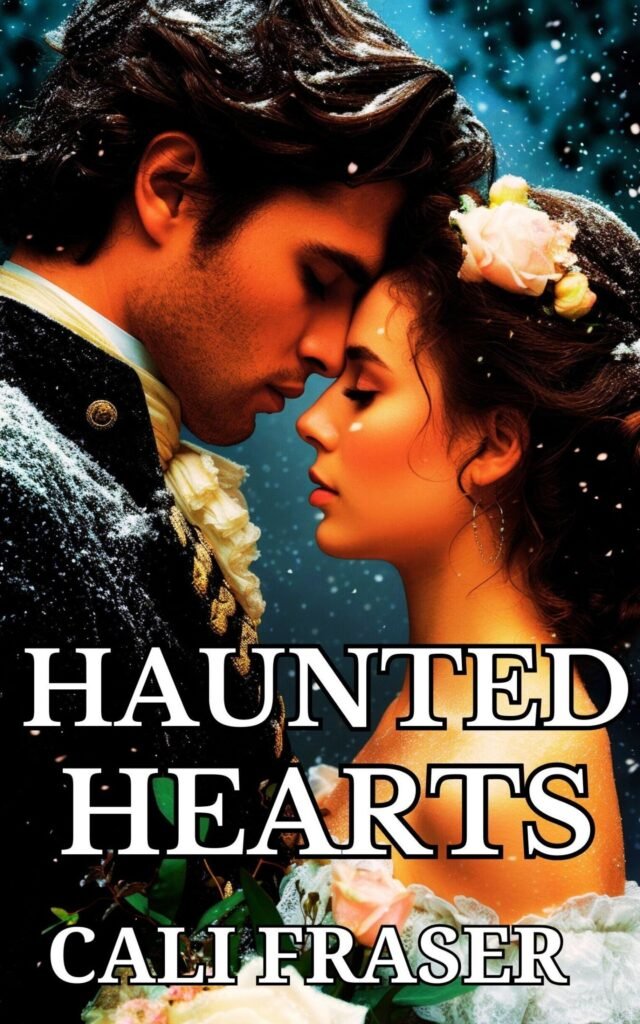
Haunted Hearts Collection Books 1-4 – Cali Fraser
Four spellbinding ghostly love stories where passion lingers beyond the grave.
London had never been gentle with love, and it showed that truth openly in its architecture — cracked stone, soot-stained brick, iron gates that sang when touched. Clara Whitmore felt it the first evening she stood outside the narrow Victorian terrace on Well Walk, fog curling around her ankles as though the city itself were deciding whether to let her stay.
She did not know then that the house had already chosen her.
The House That Held His Breath
The terrace had been empty for years. Neighbours spoke of it in lowered voices, saying it had a way of lingering in people’s lives long after they left. Clara dismissed it as superstition. What drew her instead were the tall windows, the sense of quiet restraint, the feeling that the building existed halfway between centuries.
On her third night, footsteps sounded in the hallway long after midnight.
They were slow and deliberate, unhurried by the modern world. When Clara opened her bedroom door, a man stood beneath the dim landing light. He wore a dark frock coat, unmistakably Victorian, his expression gentle and hollowed by waiting.
“I was afraid you wouldn’t see me,” he said.
Edward Harrow had been dead for more than a century, yet the way he looked at her was achingly alive.
A Love That Refused to Fade
Edward died in 1893, claimed by pneumonia after weeks spent pacing the iron gate at the front of the house. He had been waiting for Eleanor — the woman he loved, the woman who never returned. A family scandal had driven her from London, and letters written in desperation were never answered.
He waited anyway.
Death did not loosen his grip on love. It refined it, stripped it of everything but devotion. Edward spoke to Clara quietly, never startling her, never forcing his presence. He told her about evenings near Bloomsbury spent debating poetry, about moonlit walks along the Thames, about Eleanor’s habit of humming while she read.
Clara listened, night after night, feeling something inside her shift. This was not fear. It was intimacy. A tragic romance unfolding slowly, rooted in emotional truth rather than flesh.
As weeks passed, Clara began to sense Edward even when he was not beside her — warmth lingering in empty rooms, the air thickening when she spoke another man’s name. Edward never accused, never demanded. His sorrow was quieter than that, seeping into the walls like memory.
Outside, London pulsed with life. Couples laughed in Camden Town. Pubs spilled light onto wet pavement. Inside the terrace, time folded inward.
This was ghostly love at its most perilous. Not because it threatened Clara’s life, but because it tempted her to abandon it. The connection felt deeper than anything she had known — and far more consuming.
One evening, rain hammering the windows, Edward finally spoke what he had been holding back.
“If I love you,” he said softly, voice trembling, “I will keep you here. That is the cruelty of loving someone like me. We don’t intend to destroy. We simply don’t know how to let go.”
Clara understood then that haunted love stories were not about fear or possession. They were about love refusing to accept an ending.
Love That Time Refused to Release
Determined to understand the past binding him, Clara searched for Eleanor. She found her grave in Highgate Cemetery, weathered and overlooked, dated to the Edwardian years. Eleanor had died young. She had never known Edward waited. Never known he died loving her.
Edward stood beside Clara as she traced the carved name with her fingers. Mist curled around them, intimate and cold.
“She didn’t abandon me,” Edward said quietly. “She simply vanished.”
In that moment, Clara understood the truth of what bound them. They were not divided by fate or misunderstanding, but by existence itself. One anchored to the living world, one held fast by memory.
To love him fully would be to disappear with him.
London Keeps What It Loves
Life resumed its rhythm. Clara remained in the terrace, though it no longer held its breath. Yet sometimes, when fog drifts over Hampstead Heath or iron gates sing beneath her hand, she feels it — the residue of a dangerous love, the echo of romantic ghosts who never truly leave.
London does not release its dead easily. Nor does it forget the love that once shaped them.
Somewhere beneath the Thames, beneath stone and time, Edward Harrow’s devotion lingers — not as a haunting, but as proof that even the most tragic romance can be beautiful when it is finally set free.